At half time, the United States leads Australia 2-0.
Early in the match between the United States and Australia, Folarin Balogun did not put his own name on the scoresheet. Still, he gave the U.S. the move that produced the lead.
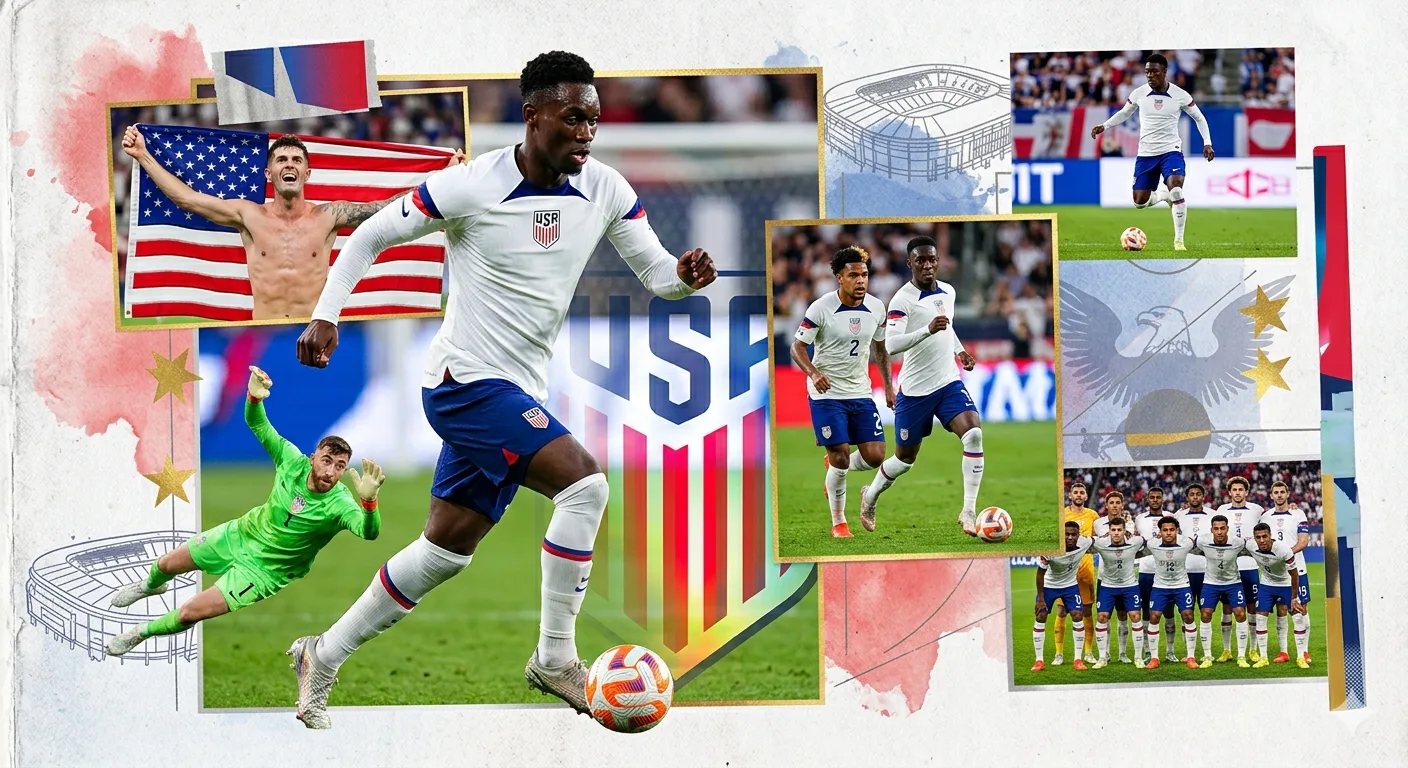
The attack started out wide.
After receiving the ball, Balogun did not slow down and wait for support. He did not recycle possession backward. He pushed the ball, and his body, straight into the space behind Australia's defensive line.
It looked simple. It changed the direction of the entire back line.
Australia's defenders could have defended facing forward, with the pitch in front of them. Once Balogun accelerated, they had to turn, sprint back toward goal, track the ball, track the runner, and judge the possible cross all at once. By the time the ball reached the danger area, Cameron Burgess had no time to deal with it cleanly. He stretched a leg out to clear it, and the ball deflected into his own net.
Officially, it was an own goal.
For the United States, it showed something else:
Balogun has now changed two straight matches in his own way.
Against Paraguay, his contribution was direct: two goals. Against Australia, his impact did not appear in the scoring column, yet it came from one of the most essential qualities of a striker: forcing the defense into uncomfortable positions and making defenders act under pressure.
There was another important context to this match.
Christian Pulisic was absent from the squad.
Without the team's most reliable attacking symbol of the past several years, the front line needed someone else to carry more vertical threat and pressure inside the box. Balogun did not try to replace Pulisic as a playmaker on the ball. He had no reason to.
He offered something different:
He kept running into the channel between the center back and fullback, dragging Australia's defensive line back toward its own goal.
That is the clearest relationship between Balogun and this U.S. team.
The United States did not need another wide star. It needed a No. 9 who could push attacks into the deepest, most dangerous areas of the box. Balogun, in turn, needed more than a national team that saw him as a backup option. He needed a team willing to hand him a meaningful role.
So when we write about Balogun, the story should go beyond "he chose the United States."
The better question is:
Why did the United States become his choice?
His identity was never a straight line
Balogun's identity was never singular.
He was born in Brooklyn, New York. His parents are from Nigeria. Soon after his birth, his family returned to London, where he grew up and developed inside Arsenal's academy.
He speaks with a London accent, and his football resume reads much like that of an English academy player: Arsenal, Middlesbrough, Reims, Monaco. At international level, he also represented England's youth teams.
From the perspective of upbringing, he easily fits into the English football system.
From the perspective of family heritage, he can also be placed inside a Nigerian football story.
From the perspective of birthplace, he naturally carries an American identity.
All three lines are real.
The problem is that at senior international level, a player gets one choice.
This kind of decision is often flattened from the outside. Some will say he picked the United States because the competition for England was too difficult. Others will say the U.S. happened to need a striker and therefore benefited from the situation.
There is some reality in those arguments, but they are too narrow.
For a player, a national team is not an ordinary job. It is not simply a matter of going where minutes are easiest. It is not a spreadsheet comparison of opportunity.
Especially for someone like Balogun, the child of an immigrant family, choosing a national team means answering a more private question:
Where do I come from?
Who needs me?
Which flag do I want to attach to my World Cup memories?
An accidental birthplace became a real choice more than twenty years later
When Balogun later spoke about the decision, he repeatedly mentioned his family.
That detail matters.
His American identity did not begin as an active decision. It came from a chance moment in his family's migration story. His mother was in New York visiting relatives while pregnant. Because of her health condition at the time, she could not fly back to London as originally planned, so she stayed in the United States and gave birth there.
That is how Balogun was born in Brooklyn.
For a newborn baby, of course, that was not a choice.
More than twenty years later, that birthplace returned to him as a real decision.
His mother supported him in representing the United States. American fans kept welcoming him on social media. The U.S. coaching staff explained the team's plan and what this young side needed.
Balogun saw the opportunity too.
This was a team still being built. This was a national side searching for its striker before a home World Cup, rather than a finished system asking him to wait on the margins.
So "America" became more than the birthplace printed on his passport.
It became a story he could complete.
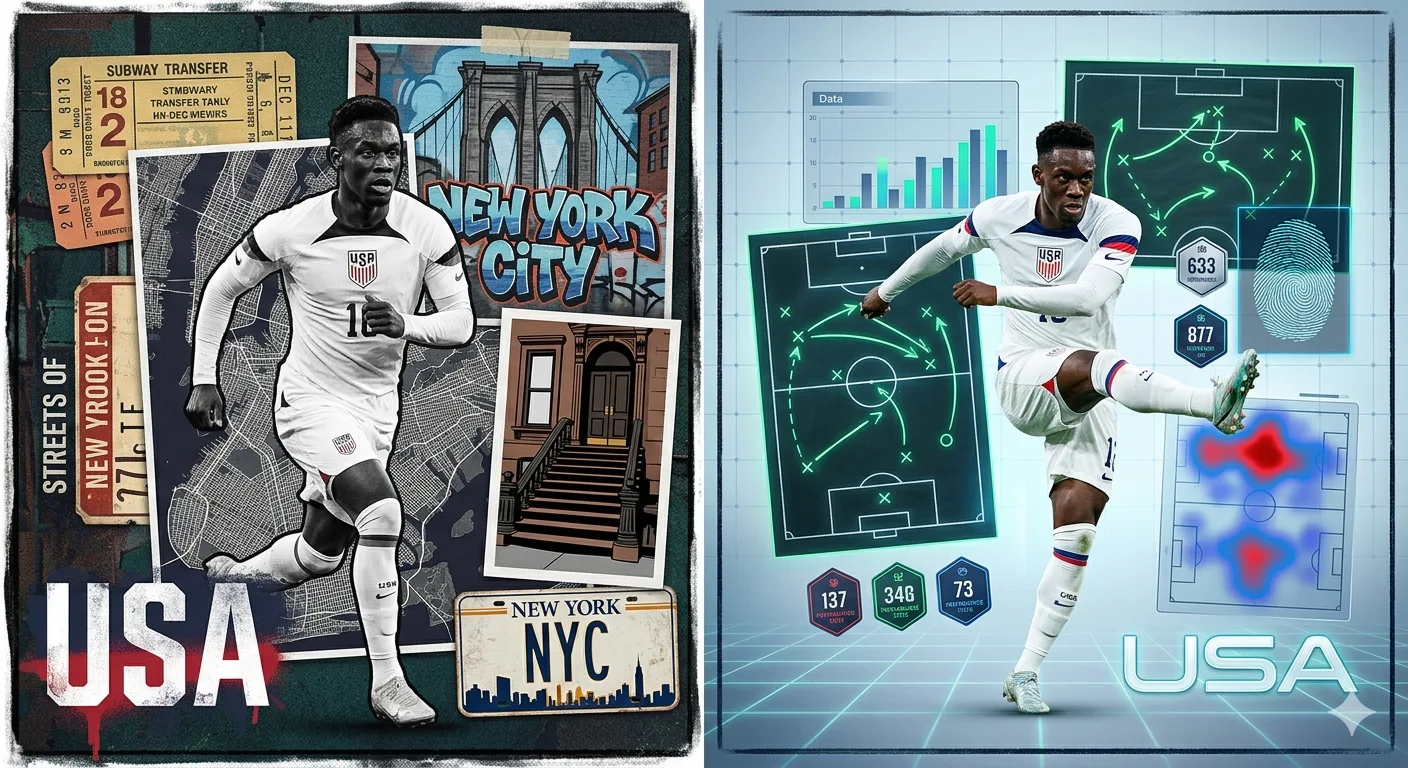
That is the logic behind his choice.
London gave him his football education. Without Arsenal's academy, without his England youth experience, without the path that later took him to France and helped him prove himself, he would not be the striker he is today.
Nigeria remains part of his family story as well. In fact, that family background is part of how he understands identity as something with multiple coordinates.
His parents' migration, his mother giving birth to him in New York by circumstance, his family returning to England afterward: all of these experiences gave his identity more than one reference point.
By choosing the United States, he did not erase the others.
At senior international level, he turned one of those coordinates into belonging.
A striker's run is also a choice
That is why today's forced own goal fits so naturally into his story.
A striker's movement is also a form of choice.
When to stand in front of the center back. When to drift wide. When to run in behind. When to drag a defender away. These decisions do not always appear in the technical statistics, yet they change matches.
Balogun's value to the United States works in a similar way.
He will not finish every move himself. His presence, however, gives the U.S. attack a clearer direction.
Against Paraguay, his two goals answered the question of whether the U.S. had a finisher.
Against Australia, with Pulisic absent, he answered another question through one run and one cross:
When the team is missing its most familiar attacking core, can the United States find another route forward through someone else?
At least in that opening goal, the answer was already visible.
Balogun starts wide. Australia's defenders turn and chase. The ball deflects into the net. The sequence needs no elaborate language. Even a casual viewer can understand the value of a striker from that moment:
He makes defenders fear the space behind them.
He is a different kind of American figure, and that is exactly where his power lies
This is also where many viewers can connect with him.
Many people do not begin life with a clean, simple sense of belonging.
Some are born in one place and raised in another. Their families carry one culture, while school and society give them another. The outside world keeps asking, "So where are you really from?" The honest answer often takes more than one sentence.
Balogun is that kind of player.
He is a different kind of American figure. His U.S. story took the long route: born in New York, raised in London, shaped at Arsenal, proven in France, and then brought back into the U.S. national team.
The power of the story comes from the detour.
After all that movement, it has landed exactly where the United States needed him most.
The U.S. has had a flag-bearer in Pulisic, a midfield spine in Weston McKennie and Tyler Adams, and veteran support from players like Tim Ream.
But to go deep at a World Cup, a team also needs a striker who can keep opposing center backs uneasy for 90 minutes.
Balogun is beginning to claim that role for himself.
His importance does not come from the United States being an easy choice.
It comes from the fact that the U.S. had a long-term problem it had never fully solved, and his ability, age, identity, and decision have converged at this home World Cup.
Some choices only reveal their meaning years later
So the opening own goal against Australia was more than a lucky lead.
It felt like a small echo.
The child born in Brooklyn, raised in London, and once eligible for three national-team paths is now wearing the United States No. 20 at a home World Cup, using his movement to force an opponent into a mistake.
Some choices only reveal their meaning years later.
Balogun chose the United States in 2023.
By 2026, as he stands on a World Cup pitch, with Pulisic absent and the U.S. needing someone to carry the attack into its most dangerous spaces, that decision has become more than a headline about switching national teams.
It has become a sprint.
A cross.
An own goal the defender had no time to handle.
And it has become one of the most compelling storylines to keep following for the United States at this World Cup:
How one player turns a complicated origin story into a clear direction.